Home » Events

Category Archives: Events

Plans for a European Centre for Human Ecology

DSCF2326

In our last newsletter, CHE Director Emeritus Ulrich Loening reported on plans for a new European Centre for Human Ecology. In case you missed it, here’s what he had to say, along with some photographs he took of his visit:

The German Society for Human Ecology has for a few years been discussing the possibilities of founding a European College of Human Ecology. Over the past two years this has developed into a fully formulated plan. I had not attended any of the annual meetings of the Society, but last June I joined them for a workshop in Frankfurt.

DSCF2368

We met first in the southern town of Emmendingen, where the Mayor and many citizens had welcomed the idea. We examined several sites which had been identified for the College. Outside the town is an organic farm around ancient historically interesting buildings, with scope to take over some buildings and build some new ones. Nearer into town is a large parkland area which is a psychiatric hospital, now reducing its local needs. It has beautiful trees, many buildings, also with scope to take on old and build new.

DSCF2336

Then right in the centre of town is an old school building and the decaying old Town Hall. Both would need extensive renovation. Also a steel factory, founded about 1860, still run by a descendant of the founding family. He runs it on a sustainable basis, not geared to maximum growth, and offered a lot of space.

`

These options each have attractive features and question the philosophical basis of what we are trying to achieve. It might be lovely on the organic farm, yet that is not the real modern world. The other extreme would be in the heart of modern industry, facing up to our global problematique. We worked through these options next day in the heart of Frankfurt, among all those financial monster buildings. The whole idea follows the College of the Atlantic, whose founding and present Deans were present, and is based on the liberal arts colleges of the USA. German universities are suffering like ours in UK, except, it seems more so. Liberal subjects like sociology are more or less dead. The possibilities for human ecological thinking and teaching have practically vanished. So the new College would provide the base for a liberal education. I had suggested, from our own experience and that of the now closed Brussels course, that a post-graduate course would be better; but the educational needs really indicated an undergraduate course of 3 or 4 years. Like ourselves and the CoA who sought us out so many years ago, the new project is keen to make international connections. So here is our opportunity to take part and contribute whatever we can offer.

DSCF2355

The most immediate plans are to organise an international human ecology conference for 2014, much like the Commonwealth human ecology conferences of which CHE organised the 9th in 1989 and contributed to the one in Manchester in 2009. CHE may have the opportunity to be a partner in the 2014 conference, or at least to make substantial contributions to lectures and workshops.

Library relaunch and archiving project supported by Foundation Scotland

Some of the Centre's book collection

Some of the Centre’s book collection

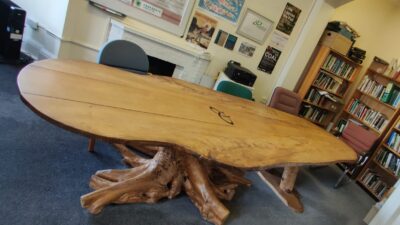
Since leaving the University of Strathclyde in 2010, the Centre for Human Ecology has been based at the historic Pearce Institute in Govan, Glasgow. As well as providing a convivial meeting space, the Centre’s home here contains our beautiful table, made by students and Tom Forsyth back in the University of Edinburgh days- complete with central CHE logo in bog oak from near Faslane nuclear base which would probably carbon date at about 5,000 years old!

CHE's office and table- complete with 5000 year old bog oak logo!

CHE’s office and table- complete with 5000 year old bog oak logo!

Also present are the CHE’s library of books on a wide variety of subjects, as well as related archival material including student theses, occasional papers and other research.

We are pleased to announce that the Centre has been awarded funding from Foundation Scotland and the Longstone Trust to improve and relaunch our library as a community resource. This will involve opening the library to the public one day a week and holding associated learning events.

the view from our window of the historic Govan Old Church: the traditional 'heart of Govan'

the view from our window of the historic Govan Old Church: the traditional ‘heart of Govan’

We’ll update the website with news of what’s happening and how to get involved, so check back soon- or follow us on Twitter!

GalGael and CHE Present:

GalGael and the Centre for Human Ecology present: A Midwinter Moot
6pm, Thursday 20th December 2012
GalGael Trust, 15 Fairley Street Govan, Glasgow, South Lanarkshire G51 2TS

Join us near the Winter Solstice for a unique evening of learning, music and fun.

Gordon Chalmers from the University of Queensland, Australia, will be here to share his ideas on ‘Family, Country, Community: Indigenous Australian Understandings of Kinship’ and we’ll all have a chance to share what family, country and community mean to us.
http://www.uq.edu.au/ugmeetingplace/mr-gordon-chalmers

We’ll also have a performance from award-winning traditional singer and musician Mairi Campbell.
http://www.mairicampbell.co.uk/

There’s also a chance to ‘gie it laldy’ on your favourite songs with the (in)famous GalGael Karaoke!

Plus shared food and a warm convivial atmosphere.

Donations welcome

See you there!

Report on Sustainability and Public Health

CHE graduate Chris Pilley has put together a report entitled “Sustainability and Public Health: A Collection of Case Studies”.

Chris has had a varied career including nearly 20 years in community based adult learning, followed by a period in green and ethical financial planning. He is a long time member of CHE and completed the MSc in Human Ecology (distinction) in 2001. Since then he has been combining project work in an Edinburgh Community High School, with a number of freelance activities, of which this publication is one.

According to Chris:

While I had been given a specific brief by UKPHA (described in the Foreword and reflected in the choice of case studies), I was very aware of my debt to the wider CHE community and to the CHE MSc in particular in approaching it. UKPHA had started to show an interest in what was called “ecological public health” and part of the intention in the report was show how aspects the two worlds had much in common. I was also seeking to broaden the notion of “sustainability” beyond the common focus on climate change alone.

You can download the report from the following link: Sustainablity and Public Health: A Collection of Case Studies